
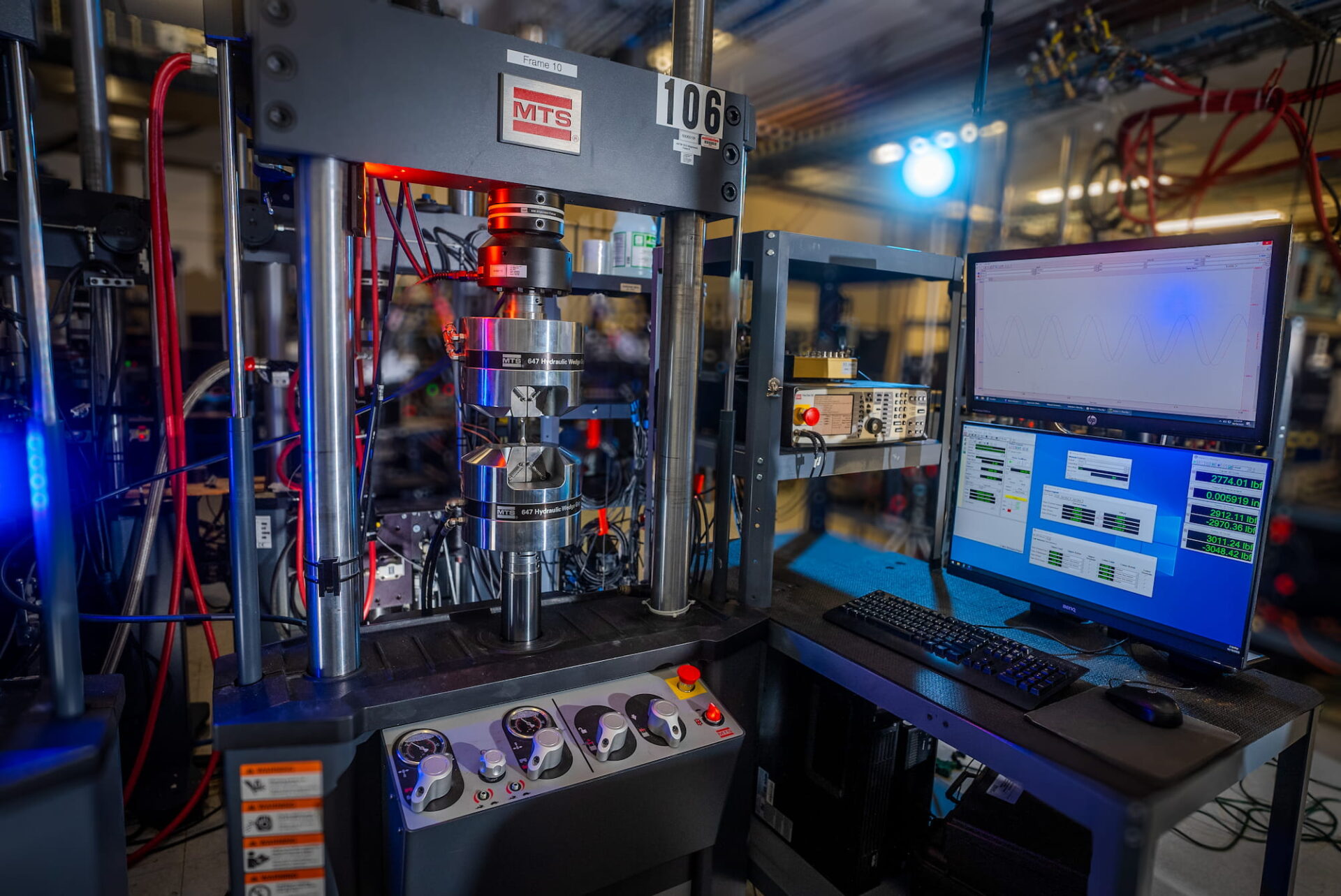
Mechanical performance is directly tied to a material’s properties. The best way to assure the performance of test materials or developed products is with a rigorous characterization through a series of destructive tests that identify breaking points. For all materials, a profile through various mechanical testing lab evaluations will aid design teams in selection criteria to optimize product applicability.
LTI’s Mechanical Testing Lab
Capabilities
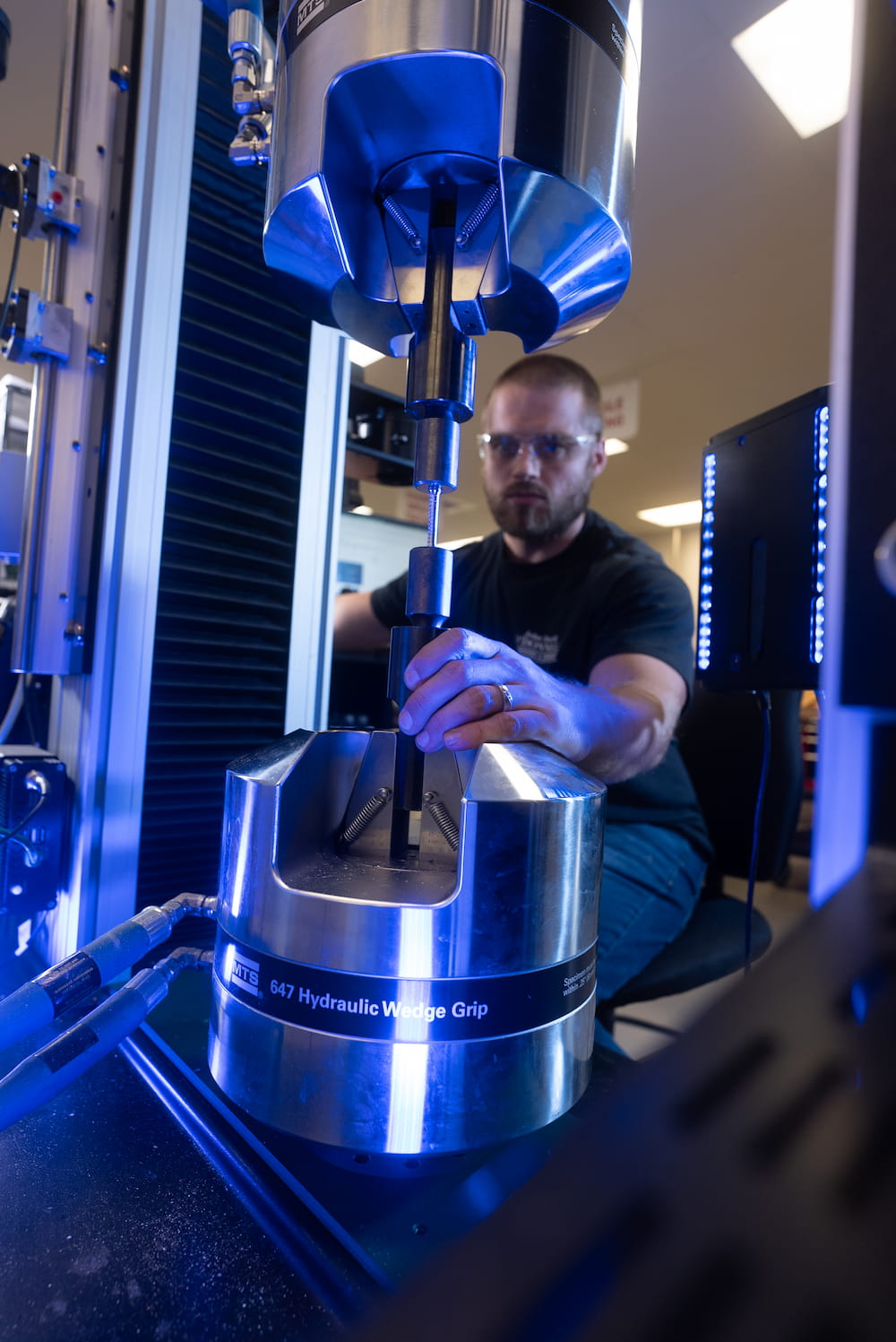
Tensile Testing:
Our advanced Tensile Testing machines, ranging from 8 ozs. to 600,000 lbs., assess the strength of various materials. We also offer plastics testing with a 10,000 lb. capacity tensile machine
Elevated and Sub-Ambient Temperature Tensile Testing:
Experience precise Elevated Temperature Tensile Testing with our furnace carousel, capable of processing up to three specimens simultaneously, with test samples heated to temperatures as high as 1800°F.
Stress Rupture and Creep Testing:
Our Stress Rupture and Creep Testing adhere to ASTM standards and can be conducted at temperatures reaching up to 2000°F.
Fatigue and Facture Testing:
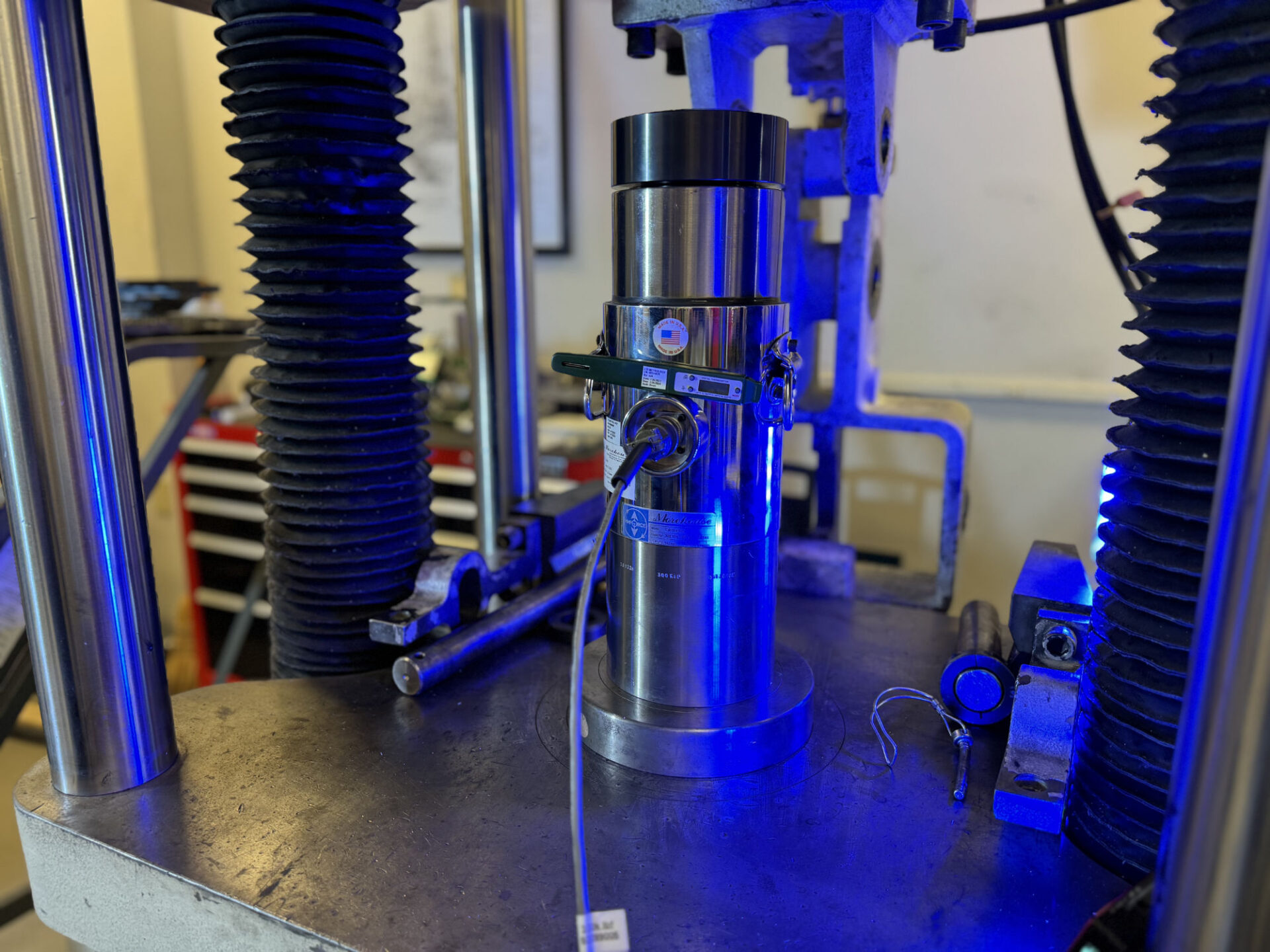
Using equipment capable of generating up to 100,000 lbf., we offer Fatigue Crack Growth, Fracture Toughness and High/Low Cycle Fatigue Testing, controlling test temperatures from sub-ambient to elevated temperatures.
Impact Testing of Metal:
Our Impact Testing services cover a wide temperature range from -452°F to +500°F, offering impact energy of up to 320 ft. lbs. We conduct Charpy V-notch, weld charpy, and drop-weight testing.
Hardness Testing:
We provide a range of Hardness Testing options, including Rockwell, Brinell, and Superficial Hardness Testing for metals, as well as the Shore Durometer test for plastics.
Welder & Procedure Qualification:
Our comprehensive Welder & Procedure Qualification services meet various specifications, codes, and standards, including MIL, API, ASME, AWS, ASTM, EN, and the Pressure Equipment Directive.
Test Specimens for Mechanical Testing:
Our fully-staffed Machine Shop operates on two shifts to prepare precision test specimens for all mechanical testing needs. Specimens are machined according to ASTM standards.
Heat Treat Capabilities:
In-house capabilities to process metals through process such as annealing, normalizing, hardening, and tempering with capacity of over a dozen furnaces.
Tube Testing
- Flaring
- Expansion
- Flattening
- Tensile testing (full-size tubing)
Fastener Testing
- Yield strength
- Axial and wedge tensile
- Proof loading
- Cone strip test
- Double shear
- Flattening
- Hardness testing
- Magnetic permeability
- Hydrogen embrittlement/stress durability
- Tension fatigue
Other Services
- Hydrogen embrittlement/stress durability conductivity
- Magnetic permeability
- Compression testing (per ASTM E9)
- Proof loading
- Bending
- Hardness testing (Rockwell, Superficial Rockwell, Brinell, Vickers and Knoop microhardness)
- Stress rupture
- Creep testing
- Fracture and fatigue testing (crack growth, fracture toughness, high- and low-cycle fatigue)
- Impact testing (Charpy U- and V-notch, drop weight)
- Tensile testing (machined specimens, full-size rebar and tubing, elevated temperature)
- Shear testing (per ASTM B769 & B831)
- Pin-type bearing testing (per ASTM E238)
- Welder and procedure qualification
Quality and Qualifications
Mechanical Testing FAQs
Find answers to common questions about mechanical testing services, turnaround time, and certified test reports.
1. What is mechanical testing?
Mechanical testing evaluates how a material performs under different forces and conditions. It can include tests for strength, hardness, fatigue, ductility, and other characteristics that help determine whether a material is suitable for its intended application.
2. What types of mechanical testing does LTI offer?
LTI offers a range of mechanical testing services that can include tensile testing, hardness testing, fatigue testing, impact testing, stress rupture testing, and other evaluations used to assess material performance and service life.
3. What is the difference between destructive and nondestructive testing?
Destructive testing measures how a material performs by pushing it to failure or permanently altering the sample. Nondestructive testing evaluates material integrity without damaging the part. Mechanical testing is typically destructive because it is used to measure performance characteristics such as strength, ductility, or fatigue resistance.
4. Do you provide certified test reports?
Yes. LTI provides certified test reports to document the testing performed and the results obtained, helping support quality, compliance, and customer documentation requirements.
5. What turnaround time do you offer for mechanical testing?
Turnaround time can vary depending on the type of test, sample requirements, and project scope. Contact LTI with your testing needs and timeline, and our team can help define the best path forward.
Partner With LTI Today
Laboratory Testing has the capacity and capabilities to handle all your material testing needs in a single location. Since 1984, we’ve aided customers worldwide with accurate nondestructive testing and precise material lab services. Request a quote or contact us today to see how our industry-leading turnaround times can keep your mission-critical approvals moving forward.