• FREE email and fax certifications
  • FREE pick up and delivery within 60 miles of LTI
  • Same day, next-day, and 2nd-day rush service available
  • FREE online order tracking at LTI Live Update with up-to-the-minute job status
  • Accredited by A2LA to ISO/IEC 17025 and by PRI/Nadcap

Employee Directory Contact Us Accreditations RFQ

OUR CUSTOMERS SAY:

“I wanted to say thank you to the LTI Team for all the support they have provided in our source inspections, as well as on expedited projects. It is nice to work with a group that not only has technical knowledge, but cares about getting the job done right the first time. I know I can count on the LTI team to help me in many situations. N.G.K. Metals looks forward to many more years of working with you.”

David Britt,
N.G.K. Metals Corp.

» READ MORE TESTIMONIALS


Connect with us!


We Accept:

Weld Testing

Welder Qualification and Welding Procedure Qualification

Welder qualification tests are intended to determine the ability of welders and welding operators to make sound welds. Organizations qualify welders or welding operators for each welding process used in production welding.

Welder qualification is testing performed on a weld to confirm that results meet the requirements specified in a procedure. The results of weld testing are used to qualify a welder to a stated procedure, often as part of pre-employment screening, by ensuring that the skills of the welder meet code and/or the company’s standards and for welder certification. In the United States there are a number of organizations that have certified welding procedures. Some of the largest organizations include the American Welding Society (AWS) typically dealing with structural codes for buildings and bridges and the American Society of Mechanical Engineers (ASME) dealing with boiler and pressure vessel codes.

Laboratory Testing Inc. offers independent, third-party weld testing services for welder qualification or certification and welding procedure qualification. All of the required weld testing and inspection are provided to verify that the weld procedure was followed correctly, correct filler material was used and the weld joint lines up properly. LTI’s full scope of capabilities include the following:

  • Welder Qualification Testing for performance qualification and welder certification to ASME, ANSI, AWS and API code and Military standards
  • Preparation of Welding Procedure Qualification as per client or project requirements
  • Documentation of the Welding Procedure Qualification in a Certified Test Report as per ASME, ANSI, AWS and API code and Military standards
  • Coupon Testing as per Welding Procedure Qualification which includes visual examination, mechanical testing, metallographic examination and nondestructive testing

Laboratory Testing is a full-service weld test and welder qualification provider with complete in-house resources to turn your order around quickly and reliably. Our staff includes an AWS Certified Welding Inspector and Level II Inspectors in Visual Examination. The lab also has a full-service Machine Shop equipped with band saws and CNC milling, turning and grinding centers to handle any size weld coupon. The Machine Shop and testing labs run first and second shifts to process the orders under tight deadlines.

Weld Test and Welder Qualification Processes

A few types of weld testing are performed in LTI’s Metallography Laboratory – macroetch exam, hardness testing and ferite examination. The macroetch exam is typically performed on a finely ground cross-section taken transverse to the weld axis that has been etched with a chemical reagent to distinguish the weld, HAZ, and base metal areas. Examination for characteristics such as weld size, fusion, penetration, profile, and weld discontinuities is performed at magnifications anywhere between 1X and 50X. Various AWS, ASME, military, and customer specifications call for macroetch examination.

The weld test for hardness is done on a ground and etched sample, similar to the macroetch specimen. The most commonly employed scale for weld testing at LTI is the 10 Kg Vickers. This generally involves checking the hardness in all three zones, including weld , HAZ and base according to a pattern prescribed by the referenced specification. Hardness testing of welds is an extremely common practice and requirement in the oil and gas industry. One of the most commonly encountered specifications being NACE MR0175 / ISO 15156, and or a company-specific derivation.

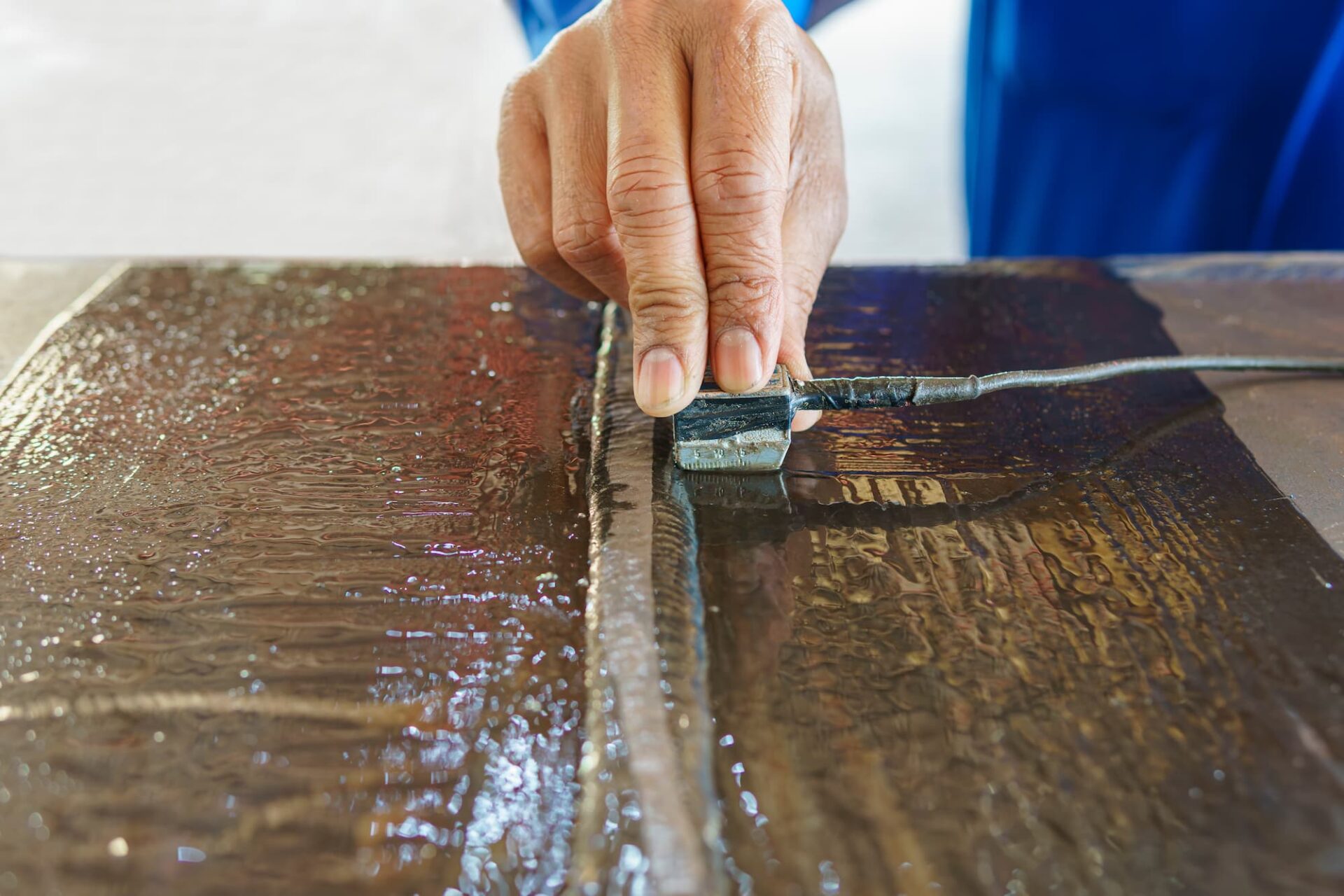
Ferrite examination by the point count method and feritscope are performed to determine the amount of ferrite present in the weld metal, HAZ and/or base metal. The point count test is performed on a polished and etched cross-section of the sample per the point count method described in ASTM E562 or a company-specific derivation. The point count test is typically applied only to welds that involve the duplex stainless steels. Ferrite examination by feritscope is a nondestructive test performed with a contact probe that calculates ferrite via electro-magnetic response. This test is typically applied to welds that involve the austenitic steels.

LTI’s Chemistry Lab analyzes weld overlays as well as raw materials using various methods that include dilution analysis for overlays and Inductively-Coupled Plasma Spectroscopy (ICP) and Atomic Emission Spectroscopy (AES) for raw materials. The weld dilution test is used in weld qualification and involves dilution of the weld metal by the base metal following procedures to perform the test at specific distances from the base metal. The weld metal analysis is usually performed to AWS or ASME Part C specifications.

Both mechanical and nondestructive testing methods provide necessary information for welder qualification and procedure qualification. LTI offers Visual, Liquid Penetrant, Magnetic Particle and Radiographic Inspection for nondestructive evaluation. These tests are usually done in conjunction with applicable mechanical testing such as tensile, bending or impact testing according to the same specifications.

Weld Testing Methods

Metallurgical Testing

  • Macroetch
  • Vickers Hardness Testing
  • Ferrite Exam –Point Count and Feritscope

Chemical Analysis

  • Dilution Analysis
  • Inductively-Coupled Plasma Spectroscopy (ICP)
  • Atomic Emission Spectroscopy (AES)

Corrosion Testing

Mechanical Testing

  • Tensile Testing
  • Guided-Bend Tests – Plunger Type and Wrap Around Bends
  • Charpy Impact Testing
  • Drop Weight Testing
  • Nick Break Tests
  • Push Out Tests
  • Peel Tests
  • Section Tests
  • Hardness Testing
  • Fracture Toughness

Nondestructive Testing

  • Visual Examination
  • X-ray/Radiographic Inspection
  • Magnetic Particle Inspection
  • Liquid Penetrant Testing